Title: Tangled
Produced
by: Walt
Disney
Release
date: 2010
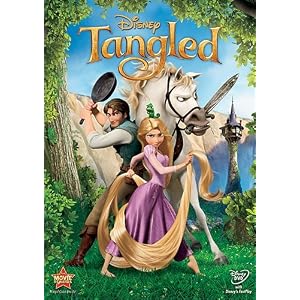
So,
when I was growing up I was pretty much obsessed with fairy-tales
(which nicely foreshadowed my adult addiction to speculative
fiction). One of my favorite fairy-tales of all time was Rapunzel.
I couldn't really say why, in retrospect, but I loved this story. And
when I was a child I really, really wanted Disney to make a movie of
this story. So, when I belatedly realized as an adult that this
childhood desire had finally come to pass, I immediately tracked down
the film. (I say immediately, I was only two years late, after all!)
Tangled
is Disney's adaptation of the Rapunzel story. For the first third of
the film, I was largely underwhelmed. The film begin with Rapunzel's
mother extremely pregnant and deathly ill. The witch, by contrast,
apparently has some magical flower that keeps her eternally young and
beautiful (a primary goal of most witches ). Well, word of this
flower's existence reaches the king (did I mention that, in this
version of the story Rapunzel's parents are royalty?) and soldiers
march out to collect the flower. It's taken. The Queen lives. Either
the King doesn't realize that the flower belongs to the witch, or
decides not to compensate her for her loss because, well, he is the
King (so maybe all the land, and the flowers, really belong to him. I
don't know). The witch has lost her flower, but somehow discerns that
its magical healing properties have been transferred to the Queen's
fetus, and so steals Rapunzel away from her royal family in the
middle of the night. It's only fair, the flower did belong to the
witch, after all. And now, apparently, Rapunzel possesses the essence
of the flower, so now that essence probably belongs to the witch,
too. Unfortunately, the essence now comes in a baby-package and has
to be cared for and raised. Longevity has become pretty taxing. I
almost feel sorry for the witch.
And
I'm confused about this passing of the flower-essence. Is Rapunzel
going to keep aging? She certainly turns from a fetus to a baby and
to an adolescent, so she looks like she's aging. What happens to the
flower essence when Rapunzel dies? Maybe it gets passed onto her
kids?
I know, I know, I'm over-thinking it. Anyway, it's not exactly like
the original fairy-tale of Rapunzel was a shining example of
air-tight story-telling, or logical thought process. This retelling
of the Rapunzel story has a lot of bonuses over the fairy-tale that I
loved as a child. For one, the reason behind the witch's desire for
the child is clear. For another, the reason behind the witch's desire
to lock Rapunzel up in a tower is also clearly explained. Rapunzel is
essentially a walking, talking fountain of youth here. She's a rare
commodity. So of course you'd want to protect her from thieves once
you've rightfully stolen her.
If you don't know the opening of the original Rapunzel story, here is
the version I knew as a kid: Rapunzel's pregnant mom gets a strong
craving for radishes and feels like she will die without them. This
is usually played up as an extreme case of odd pregnancy cravings.
So, Rapunzel's dad sees a bunch of really good looking radishes in a
garden. He thinks of his poor wife (and his own apparent incompetency
as a farmer), and he hops the fence into this garden and steals a
pile of radishes. But, in addition to being a poor farmer, he's also
a poor thief, and he gets busted by the witch (who owns the garden).
She says he can have the radishes if he give her his first born
child. (because baddies in fairy-tales always want first-born kids,
that's why.) He agrees, and takes the radishes home. When Rapunzel is
born, the witch shows up, and dad has to explain to mom where those
radishes came from all those months before. Then, having secured the
first-born child, the witch locks her up in a tower. Why? I have no
idea. Given my experience of fairy-tales, I sort of expected the
witch to eat her. Maybe she's saving her for later, okay?
Compare the two intros:
Downside to the original: there is no explanation as to why the witch
would want this kid, other than the typical fairy-tale assumption
that witches are always out to get babies. (get babies and retain
their own youth, do fairy-tale witches know something we don't?) It's
also not clear why the witch would lock this kid up, since her
parents are peasants and probably aren't going to come storming her
house with an army demanding the return of their child anytime soon.
Disney's version has the original beat here.
Upsides to the original: Simply put, it's funnier. I enjoyed
imagining the scene where the desperate father makes a reckless
bargain with the witch to satisfy his wife's cravings. It illustrates
that parents can make mistakes too, and avoids any gooey reunion
between a parent and long-lost daughter. (Oh come on, you knew that
was coming in the Disney film. That doesn't count as a spoiler.) In
addition, Rapunzel has the distinction of being a fairy-tale heroine
who isn't a princess. She's just the daughter of peasants. That's
pretty rare.
So, I was a bit upset with Disney for altering Rapunzel's back-story
so drastically such that she becomes a princess, and her parents
never made the bargain to give her away to the witch. But these
complaints are just the bickering of someone who loved the original.
If you didn't love it, or don't remember it, these points won't
matter.
Points that might affect your enjoyment of the film:
Characters:
The hero, Flynn Ryder, is hilarious. Just as Rapunzel has morphed
into a princess from a peasant, the prince from the original story
has morphed into a con-artist thief. He's an entertaining character
and given some brilliant lines. There is also a pretty funny horse
who seems to think he is a dog (seriously, a horse that tracks like a
blood-hound with his bum in the air and his nose to the ground,
priceless). Rapunzel herself is a bit too sugary sweet, (and is even
dressed in a pale pink dress with puffed sleeves) but that's mostly
easy to overlook. So the hero and horse-dog held my attention and
were good for several laughs throughout the film. The other
characters in the film were mainly forgettable, but not annoying.
Plot:
While I gave Disney credit for taking a mostly nonsensical opening to
the fairy-tale and updating it so that its actually coherent, this
coherence doesn't carry through for the rest of the plot. At one
point a bunch of blood-thirsty thieves are all turned into sappy
do-gooders based on nothing more that Rapunzel's sugary-sweet
presence and a sub-par song. Later in the film, these reformed
thieves just happen to show up at the right time to save our hero,
though the explanation for why they were able to do this is a bit
fuzzy. Wait, actually it's non-existent.
Music:
Like most of Disney's film adaptations of fairy-tales, this is a
musical. The music is pretty bad, but probably no worse that most of
the other films. So if other Disney musical scores didn't annoy you,
this one probably won't either. It seems to me to be less imaginative
than some of their other musical efforts, but it's fine.
Visuals:
Rapunzel's hair was awesome in this film. I loved it. It essentially
dominates pretty much any scene it's in.
Resolution:
Don't read this if you plan to see the film. Skip to the next
paragraph now. . .
Okay, if you are still reading, here's where I got upset again. In
line with the original Rapunzel story, the witch in this story is
killed. What's odd to me is that she's also raised Rapunzel to think
of her as a mother. So, essentially, Rapunzel's mother is killed, and
Rapunzel is present to see it. But she gets over this pretty quickly,
without really shedding any tears. I suppose finding out that you're
a princess helps you deal with things like your dead mom. The film
spent a lot of time illustrating the bond between Rapunzel and her
'mom,' so I found this hard to believe. Again, I'm over-thinking it.
But I wasn't alone in the crowd of people I watched this with in
raising an eyebrow when Rapunzel tears up a bit, and then in the next
scene is fine.
Overall, I was amused. I think the thing that put me off the most was
the music, and the need to transform Rapunzel into a princess. These
factors were mostly offset by the hero and the horse-dog. Yes, I
found the resolution a bit odd, the heroine a bit sickly-sweet, and
the music a bit bland, but this is a Disney film intended for kids. I
think kids would enjoy it, based on the hair, Flynn Ryder and and the
horse-dog, if nothing else.

